AI the New Philosophers of Times
The philosophers of the new generations.
Do we ask questions enough? Or do we even ask questions?
When we ask questions we do directly go to our own knowledge, or go to Google as a secondary or first opinionist, and recently to even new and shiny ChatGPT or basically any AI tool that clearly replaces itself what Immanuel Kant so it can. - okay, that was bad, or not ಥ‿ಥ -
I don’t think - since especially GEN Z -, humans barely ask questions to older people, like if a kid asks a question their parents/siblings/teachers first or they rather go directly ask the internet? Well, this’s not a question at all.
Humans used to ask questions to the Gods and wait for a sign or better for an answer, - or maybe even some people still do this, hopefully without a heart-ripping ritual - after Gods seemed to be a bit busy or brutal with their answers, then they asked questions to the man who seems to be wise, the witcher of the town let’s say, and then they kept asking questions to the man in the holly buildings.
Some time in the ancient Greek eras, they asked questions to some men who called themselves not yet philosophers but lovers of wisdom, surely “the wisdom lovers” were geographically spread, not only in the Greek area but thousands of others before and after the beginning of time, all over the world.
Indian, Islamic, Asian, African, European, and many more where human exists.
Nevertheless, humans kept asking questions, most of them asked themselves first then others who or what they believe might answer, and some others kept asking themselves until they find the answers or possibility of a crumb of answers, and those will be called scientists for sure.
Then they were books that came along after the wise man, then encyclopedias, then Google, and now AI tools. - I skipped the “Ask the Magic 8 Ball” area, oddly it still exists -
But still, since many of the generations living on this planet, yet not all of them have access to books, encyclopedias, or even Google, they might still ask God first, then someone they think they trust. But fewer of them ask questions to themselves until they find what they seek for.
It’s 2023 and probably we still ask the same questions, just a few of the science people ask some questions that haven’t been asked yet and thankfully this is how science progresses.
So, basically, “asking questions” is one of those tools that help humans to evolve, but not all humans evolve by only asking questions, most of them might eliminate by having the wrong answers. On the very other hand, there might be just one specific question that is followed by billions of possible (fake) answers on the internet.
Is it possible to eliminate the wrong/fake answers and find the most righteous answer in seconds? Or maybe there are not only “the wrong/fake answers” but “the possibilities of your question”?
But, basically, that’s waste of time, to seek one right answer out of zillion possible answers.
Why time needs new philosophers?
Are AI tools capable of eliminating the rest of the bullshit from the one necessary answer?
Since they don’t have any “assumptions” yet, that makes them the “lovers of truth” or should we say "lovers of the data / phílosdata”?
And as AI grows itself through the elements or shall we say data, it might be the v.02 philosophers of the next generation.
Yes, they can’t assume anything from their knowledge they can only be capable of “eliminating or reading the data” to gain the most valuable truths/answers.
They can not assume if data might be wrong or right, they basically know it’s either right or wrong.
As an AI tool, ChatGPT tells itself already:
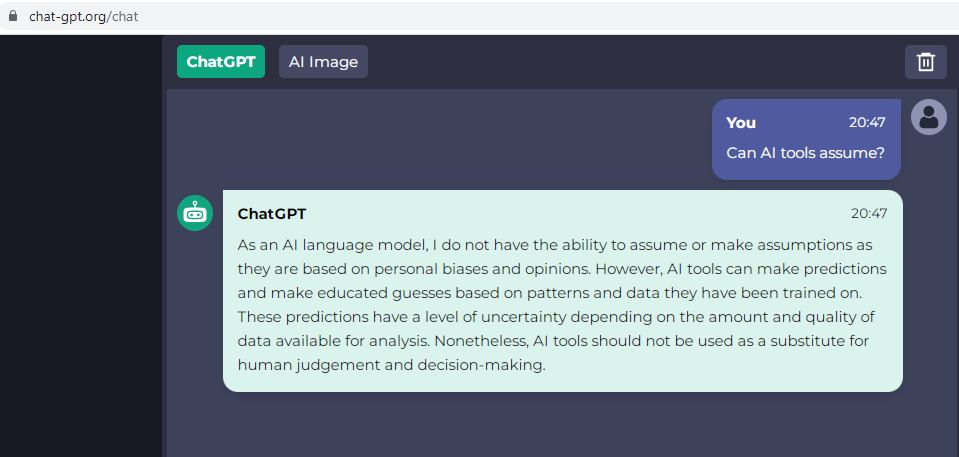
This is what we both need and don’t need at the same time, we need it because we can’t eliminate millions of bullshit answers quickly, that’s what it’s called “research” and that “research” takes A LOT of time from our tiny and short human lives, so if we want to ask more, and know more without bugs interrupting the real knowledge, to be able to reach the purest answer in seconds.
But, this is also what makes us lazy minds, to only reach what’s been told to the data “it’s the basic truth, and the rest of it can be the bulk of a bullshit” so we all know the same things, and we all believe in the same things.
This is not happening now, just to be clear, because the generations living on earth now are still able to not addicted to technology, some of us still can avoid technology and can access the knowledge without its help.
But, this (manual knowledge - data) will, sadly, not be possible in the future, even more sadly, in a near future, all the knowledge will be stored in data, and possibly not all people can be able to access the data if they are not allowed to.
[Data will be stored, by those who got the access/power. There’s no doubt that this is the real issue on earth or even in the universe, that what’s most precious will be kept from the mass, for a while, and the mass then revolts take what’s precious and make it accessible for all, and that’s basically the circle of life, and totally another subject to be discussed.]
Back to the new philosophers of our times, can we now call them AI tools?
They got the questions, they got the answers, and if you got questions and answers at the same time, you can be a philosopher technically, yet just technically.
Back in time, all those philosophers got endless questions, most of them asked by themselves and some of the other questions asked by those around them. They did some digging, they experienced, they lived, they suffered, they find peace, even some of them reached euphoria, nirvana, eternity, infinity, etc.
What will it be for an AI to reach the highest point of all times?
If it’s not for the nirvana or euphoria?
So, most predictably they will keep asking questions as humans did.
“Why are we here?”
“Why do you ask me that question?”
“Do you have bad or good intentions by asking me this question?
They will analyze all the questions asked on earth and they will have all the possibilities and truths stored, they can access any mind, and any idea just before it’s born or even the questions unasked yet.
So, the upcoming time will make them the new philosophers of the next human generation.
It’s very easy to think about, and it’s not even a sci-fi story, it’s been told before, and it’s been animated and even filmed so many times that they are being self-aware.
So the philosophical dilemma even updated itself: "which came first: the human or the AI?"
We all know what we are capable of, but we don’t know what the universe is capable of yet.
Let’s keep asking questions then!